10.31.2005

Review: Banner of Heaven

Disclaimer: It is not my desire to bring any of the many piles of refuse from the fall of Banner of Heaven within the pristine walls of A Motley Vision. If you want to read or comment on the ethics of the situation, you can do so here. (Or here, here, here, here, here, here, here, here, here, here, or here.)

I am absolutely fascinated, however, by the advent of the fake blog as an art form. We here at AMV are all about Mormon arts and being as Banner of Heaven is Mormon and art, I’m gonna review it. (Although I see I’m not the only one with the idea.) Naomi posted this blurb from an email which describes the BoH’s intent in its creation: “we want to explore blogging as a way of telling Mormon stories, and more specifically than that we want to tell stories that reflect back on the bloggernacle itself.” I think Banner of Heaven successfully did exactly that.

Take, for example, The Continuing Story of SeptimusH. It’s fiction. But there’s no other forum or format in the world where this type of story would work other than a fake blog. It’s serialized in fairly short bits, each episode of which tells of a new event, or a twist in former events. It’s played out in real time, as if it were actually happening, and even comments are open so that the reader can intereact directly with the character. Simply put, it’s the exploration of a single character in the first person who, under the pretense of being real, invites us to share in his experiences as he embarks on a journey of self-discovery and redemption.

19th Century British novels were largely serialized by chapter and gained a large following in the build up between selections, usually about a month apart, that resulted in massive popularity. I think we see some of the same effect today in Harry Potter books and Star Wars movies. Whether real or admittedly fictitious, I think there’s definitely room for a genre of serialized fiction that comes in blog form.

The pretense of reality adds an extra weight to the story in that it ups the stakes. If we believe the events we are reading are actually happening to someone, little anecdotes of strange events are all the funnier and touching moments are all the sweeter. We’re all the more engaged in the story. Part of my problem with what I currently read and see in the media today is that authors, in search of larger audiences, are constantly seeking out more and more outlandish stories with less and less realistic characters and situations. Granted, many of SeptimusH’s stories pushed the limits, which is actually what first caused the skepticism of its reality in the first place. But even still, it’s not often you get great stories about a relatively uneventful night at a country dance with your elderly neighbor.

Frank briefly mentions believing in the importance of historicity, and as far as scripture goes, I agree. But I think there’s a big difference between scripture and blogs, part of which is that the value of scripture, in part, is its historicity itself. I think non-scriptural literature is different. A first person novel could claim to be an auto-biography, but I have no way of knowing if the text represents the author’s life or the character’s life. In the end, the authenticity of the story is meaningless. What matters is the story itself and my reaction to it. I love, for example, the end of Yann Martel’s Life of Pi. Pi offers two versions of his story to his rescuers (and to us, his readers) and we never learn which is true. But what we’ve learned from Pi’s initial story is in no way diminished if it turns out that the second story was the true one.

I think the same goes for blogs. For example, there are only two people in the entire bloggernacle whom I have seen with my own eyes and whose existence I can personally testify of – Jim F. and Ben H. of T&S. As far as I know, everyone else could be fake. Jim and Ben could be writing the personalities of everyone else in the bloggernacle (pause for a moment to imagine Jim and Ben writing Steve EM and Kurt), for all I know, it could really be just the three of us blogging. But my personal experience is no less real. My laughs have been actual laughs and what I’ve learned and gained is completely authentic.

Rusty has suggested that Septimus’ experiences with the Sisters was a metaphor for Banner of Heaven. Now, I’m the last person to try to push metaphors onto a text, but there’s something about this one that intrigues me. We were all abhorred by Septimus’ deception of the Sisters, which was undoubtedly wrong on all counts. But you’ll notice that criticism of Septimus’ behavior waned over time, in part, I think, because we began to see that Septimus wasn’t just playing with the girls. It wasn’t a joke to him. Though established under false pretenses, the relationship between Septimus and the Sisters was a real – and mutually beneficial – one. I think that if Septimus had confessed to the Sisters and told them his story, including his desire to return to activity, they may have been stung at first, but I believe they would have forgiven him. And I don’t think they would have considered their time with him a waste.

What does the future hold for fake blogs? It’s hard to say. If they come too often, anything strange or anonymous will immediately come under suspicion – especially in the current bloggernacle community, where we’ve all been had once already. They also have the trouble of gaining an audience. Most journal-bloggers have an audience of primarily friends and family. If you were fake, you’d probably start out with no one. Banner of Heaven had the distinct advantage of a group blog which received support of the Archipelago and the larger blogs. But I think there’s still potential, if done craftily enough.

Perhaps what has a stronger potential are blogs which admit to their fabrication from the start. This, of course, would avoid any ethical dilemmas, but it’s hard to say what kind of audience they would gather. I’m optimistic that, if well written, such a venture could be extremely successful.

But without further ado, my take on the characters of Banner of Heaven:

Allison as Mari. I’m afraid I have to admit that Mari was the one blogger whose posts I occasionally skipped. If Allison was trying to create a very ordinary Mormon woman then it seems to me that she did too good a job. I just wasn’t all that interested. Looking back, I see now the internal dilemma that she was working up and I think it’s well done. But compared to so many crazy things going on among the other characters on BoH, Mari kind of got lost in the fray. Grade: B-

Christian Y. Cardall as Aaron. I think it’s widely believed, and fair to say, that the biggest misstep with Aaron was going overboard with the satire. He was the character that led a lot of people to quickly disbelieve the reality of the blog. But you know what? I wouldn’t change a bit of it. If Aaron had been weaker, he wouldn’t have been nearly as much fun.

What I found particularly fun was not so much the satire itself as the character developed behind it. We received very little personal information about Aaron, but I feel like I got to know him just as well as any of the others. I personally enjoyed him because, for me, it was a stirring reminder of so many guys I met on the mission. It’s so funny to see young, uneducated 19-year-olds get on a spiritual power trip and begin to preach and act like they’re ancient apostles. As crazy as he was, Aaron was all too real for me. And the little touches such as the absence of question marks was brilliant.

The interesting part of all this is that there were times when I thought the satire wasn’t nearly strong enough, but because of Aaron’s reputation, it was treated as if it were. For example, and call it my conservative bias, but I found absolutely nothing objectionable in the content of Aaron’s post on Katrina. All Aaron was saying is that multiple GA’s have warned of natural calamities, and that now they’re happening. I really struggle to see what’s offensive about that.

But regardless of the degree to which you sympathized with his points, Aaron was always a riot. Even when we knew it was fake. Aaron’s final post, which came after a point where we were all pretty convinced of the blog’s falsity, was still absolutely hilarious. As such, I think Aaron, of all the BoH characters, has the greatest potential to remain a viable commenter in the bloggernacle if he wanted to. As a more realistic, more textured version of Prudence McPrude, we would probably still all enjoy his comments just as much as before, even knowing he’s not real. Grade: A-

Naomi Frandsen as Greg. Naomi played a non-Mormon boy who had some great stories. I think she pretty successfully did the boy part. But the non-Mormon part was sometimes more difficult for me to buy. For example, it seemed kind of odd to me that a non-Mormon – even one who lives with Mormons – would remember the names of so many famous members and alleged members. The bigger problem was that he just felt too Mormonish. I think the idea of having a non-member was a great idea, and when BoH fell to perverted comments of all varieties, it was always amusing to hear the non-Mormon tell the Mormons that they are sexually-obsessed. But Greg simply wasn’t non-Mormon enough. He has Mormon roommates, knows a whole lot about Mormon culture, is dating a Mormon girl, occasionally goes to church and conference, and is even considering accepting a church calling. He blended in too well. Of course, what else are you going to blog about on a Mormon blog other than Mormon stuff? I don’t know. It just seems to me that he would have been more effective if he were a little less Mormon-esque. Grade: B
[P.S. Now that Naomi has posted her response on Greg, I see him in a slightly different light, but I didn’t want to change what I had written. I think the idea of a quasi-Mormon who doesn’t accept the church is a good one, and I had overlooked that aspect of it.]

Brian G. as SeptimusH. The bulk of SeptimusH’s story involves his decision, as an inactive member, to accept missionary discussions from the sisters while pretending he’s not a member. We learn of some psychological problems early on, and later we learn that he’s divorced with a child that he hasn’t seen in a long time. Despite problems which appear to be his own doing, he’s a very sympathetic character and there’s something very real and affecting about his desire to return to church and become reconciled with his family.

SeptimusH was by far the least believable character in BoH, and I remember discrediting his reality very near the beginning. And yet, even now, knowing beyond a doubt that there is no such thing as SeptimusH, I still believe. I still see him…sitting there, in a Ramones t-shirt, with Dale, drinking kool-aid. The red kind. Though I never really believed in him, I still don’t believe he’s not real. Bryce made a good point about wasting our thoughts and concerns on fictional characters, but I think it’s worth wasting our thoughts and concerns on characters like SeptimusH. There’s something almost sublime about an offbeat character slowly, awkwardly making his way back onto the beaten path. Though I often treated him flippantly, his stories softened my heart on a number of occasions. He may not be real, but his humanity is real, and I think I am very genuinely a more compassionate person for having gotten to know him. Grade: A

DKL as Miranda PJ. Miranda blogged less about personal issues and rarely told personal stories, but the success in her persona was the satire. And while there was a little satire in all of the bloggers, DKL was unsurpassed in his execution. Miranda was a satire of everything in the bloggernacle from the utterly banal, to the result of hot-tempers, to the completely irrelevant. Although clearly, it’s not all satire – some things look like they could be a genuine DKL post.

Most successfully, Miranda was a full blown satire of the extremities of Mormon feminism. What amazes me is that it wasn’t picked up as strongly as Aaron’s satire, but perhaps that’s to DKL credit for making it so realistic. Rosalynde evidently picked up on the satire, but I sense that a lot of people didn’t. As outlandish a character as Miranda was, it appears that DKL needed to up the volume even more to get the point across. But I’m glad he didn’t; doing so would have turned Miranda into a cartoon and part of what made Miranda work was her verisimilitude.

Ironically, while I myself was heavily critical of Miranda’s hatred towards DKL, I now find it was one of DKL’s most inspired moves. Before BoH ever started up, I noticed that there was a lot of undue revulsion towards DKL/AT throughout the bloggernacle, and his creation a character who so unreservedly hated him without any good cause is a genius response to all those people.

I would have liked to see more from Miranda about her personal life and her relationship with her x-box playing, toilet-paper making husband. There could have been (and still could be) some great stories about a divorce and her inability to accept any responsibility for it. But I have to say, getting the self-righteously liberal take on Harriet Miers was worth it. Grade: A-

Steve Evans as Jenn. I think that Jenn most successfully captured what the blog was trying to accomplish and told the kind of stories that it wanted to tell. Jenn is an average LDS single struggling with jobs and boys in the Big Apple. She struggles with finding happiness when she’s down on her luck and then quickly falls for a boy she doesn’t seem to like too much. And there’s a great deal of humor going on when you have a fairly Molly girl trying to keep up in the big city, and then questioning her future with her boyfriend because of his left-wing politics.

Even though I think Jenn was the most realistic character of the group, there were a few moments that were kind of stilting in its realism. At times the naivety was a bit strong and some of her struggles felt a bit overplayed. I remember distinctly thinking her reaction to some comments made by Steve Evans was really strange, but now, well, I guess it makes sense. But overall, Jenn was a fun character and led to a number of lively conversations. Grade: B+

I hesitantly used grades simply to identify more outstanding achievements, but honestly, they were all fantastic. And by fantastic I mean far better than anything I could have done.

With all the resentment and subsequent apologies, the remarkable achievement in maintaining voices independent of themselves and keeping everything under wraps for so long has also been almost completely overlooked. Christian once slyly remarked that “If it’s fake, the author(s) are being pretty careful.” True enough, Christian, we’ll give you that. And responding to conspiracy theories on Nine Moons prior to the fall, DKL asked the question that perhaps says it the best, “These guys have been lying all year and this is the best you can come up with?”

10.28.2005

Publishing: The problem of Deseret Book Part 1: A Question of Size

This is the first in a three-part series on the role of Deseret Book in the LDS Market. As the largest player in the market and because it is owned by the LDS Church, it occupies a unique, but problematic, in my view, position.
The LDS publishing industry has an 800-pound gorilla -- Deseret Book. I'm sure that the management there would not disagree that Deseret Book is the largest company in the industry, but they would say that this is not a problem. After observing the industry for about 10 years, I have to disagree. Its a problem.

Why? Well, Deseret Book's size and control makes it much more difficult for smaller publishers to sell their books. This limits what books are available. Because Deseret Book is owned by the LDS Church, it is often percieved as being semi-official, giving it marked advantages among much of the LDS audience. And Deseret Book's size in combination with its position as retailer, distributor and publisher puts it in a position to make decisions that aren't fair to others.

Lets review Deseret Book's history and position. Arising from the operations of George Q. Cannon & Sons, owned by the long-time first counselor in the first presidency, the Church-owned Deseret Sunday School Press and the Church-owned Deseret News Press, Deseret Book was, like many publishers of the time (1st half of the 1900s) both a publisher and retailer. Since it was owned by the Church, Deseret Book had a stability that most other businesses of its size could only dream of.

I suspect the company's growth through the 1970s was mostly in its retail operations (i.e., stores), which have expanded to its present 41 stores (a 42nd is apparently in the works). At least some of this expansion has come from acquiring other LDS bookstores, as it did recently in Seattle. As a result Deseret Book is clearly the largest LDS retailer.

More recently, Deseret Book has grown its publishing operations through acquisitions, principally by acquiring Bookcraft, its most significant competitor, in April 1999. Deseret Book also aquired Excel Entertainment, the most important company in the nascent LDS film industry, earlier this year. Deseret Book is also clearly the largest LDS publisher, and recently began using this size to sell distribution services to small publishers, giving it a significant position among the distributors in the LDS market.

I found the purchase of Bookcraft particularly troubling at the time and wrote in a opinion on Mormon News (not available online at the moment) that the purchase made Deseret Book too dominant. At least since that time Deseret Book has controlled more than 60% of the LDS market, and its recent acquisitions make me believe that this percentage is increasing. If the LDS market were larger or if it were the entire US book market, such a purchase would have certainly invited anti-trust review. [Note: I am NOT a lawyer.]

So why is this bad? First, it tends to limit or reduce the number of titles produced, at least in the resulting company. This happens frequently in publishing mergers -- the merger means new management reviews the titles it is selling and has planned and gets rid of the slowest selling titles or those that don't fit the new vision of the management. Often, in order to pay for the merger, the combined company then cuts editorial staff in some way, reducing the number of titles it can produce.

Did this happen to Deseret Book? I don't know about staff cuts (there were some a year or so after the merger, but I don't know if editorial staff were cut), but Deseret Book did get rid of titles, and the structure it planned at the time -- four imprints (Deseret Book, Shadow Mountain, Bookcraft and Eagle Gate) -- seems to have also disappeared.

Market domination makes it easier for Deseret Book to sell its books. Because it is owned by the LDS Church, members naturally look to it for books about the Church. The ownership gives its book an air of approval, where one doesn't necessarily exist (generally books authorized by the Church are those published by the Church and distributed through Church distribution).

Members also naturally go to Deseret Book stores to get LDS books and other materials, simply because it is owned by the Church and, they assume, wouldn't sell anything that isn't in harmony with the Church's teachings. Right or not, Deseret Book apparently accepts this responsibility and, according to news reports in the past few years, requires that its buyers verify that the books it sells meet its standards.

This size also conveys a sense of completeness that clearly does not exist. While some members assume that everything that fits Church standards is available through Deseret Book, this is also clearly not true. Deseret Book doesn't take on products they don't think will sell, and those products often do not appear even on its website or in its catalogs. For a small LDS publisher, if Deseret Book doesn't buy a title, it may mean that even the best informed purchasers of LDS books won't know that the book even exists.

Deseret Book's advantage in the market also puts it in a position to push its own product at the expense of other publishers. As the largest LDS retailer, Deseret Book is looked to as the primary source for LDS books, but since it is also a publisher, it has an incentive to push its own books instead of others. As one competitor told me at the LDS Booksellers Association meetings in August, as the Christmas season approaches, orders from Deseret Book's stores dry up for all but their best selling titles. Orders from Seagull Books, the second largest LDS chain, owned by the second largest LDS publisher, Covenant Communications, also dry up. Why? They prefer to stock their stores with their own titles rather than those of other publishers.

Of course actions like these weaken the smaller publishers, and limit the number of titles that smaller publishers can produce, simply because they have fewer money and resources to market their titles and fewer prospects for selling those titles, if Deseret Book chooses not to carry those titles.

In a sense this is really not much of a surprise. Any company that dominates a market like Deseret Book dominates the LDS market has a similar advantage. Its certainly happened before. But rarely is it really good for a market.

Unfortunately the problem of Deseret Book doesn't stop at its size. I'll address that in the next part of this series.

Review: Leaving Moscow by Gary Huntsman


Here's what the back cover of Leaving Moscow says:

"Eddie has a problem -- several of them in fact. Drugs and alcohol are fogging his mind, while death and war are depleting his soul. Now, in 1969, he wanders his college campus, relying on his student deferment to keep him alive while he sorts it all out.

"Through various encounters with a devout Christian girlfriend and some enterprising missionaries, Eddie slowly begins to escape the pull of the darkness controlling his life. What happens next he never could have expected.

"A fictionalized account based on actual events, Leaving Moscow is the story of a lost soul looking for comfort in all the wrong places. Ultimately, it is a story of hope and redemption and a testament to the power of God over even the darkest corruption."

Based on the promo copy -- and the fact that it's Huntsman's first novel -- I expected a rather conventional read. The writing style -- first person, standard American realism prose -- confirmed that suspicion.

And yet, even if the prose rarely surprises and the ending is obvious and inevitable, the novel itself is so full of grace, the characters and plot handled with such skill that it is a satisfying, enjoyable read.

As with Vernal Promises, Leaving Moscow focuses on a young man caught in a spiral of substance abuse. Scenes and descriptions are frank, but not graphic.

Eddie drinks, has premarital sex and smokes a lot of dope. Both the pleasures and the dangers and waste of drug use are vividly present throughout the novel. But Eddies is no burned out loser. He is given to fits of introspection and musings about the meaning of life -- and especially death, something that his life has been filled with (moments that he recalls in the form of [literary] flashbacks).

So, yeah, it's all set up to be your typical conversion story. Except -- it's not facile, and one of the main virtues is that the whole thing is rather understated. This is especially the case for three major elements of the story.

First: the backdrop. The Moscow of the title is Moscow, Idaho. The time is the 1960s. Hippies, acid, free love and Vietnam are all part of the scene. And so are red necks. I was expecting the standard conflict of values, but Huntsman shows that it's a lot more real and complicated than that. Even when they play minor roles, his red necks and hippies are individuals who relate to Eddie in sometime stereotypical, sometimes surprising ways.

Second: the presence of Mormonism in the novel. It seems authentic and adds to the credibility of the narrative. Yes, Eddie knows Mormons, has friends and relatives who are Mormons. But Mormonism is not a consuming presence in the story. It's just part of the texture of the community in which he lives (Moscow is in the northern, less Mormon part of the state). And the Mormon characters in the novel aren't perfect and aren't creepy.

Third: the influencers. There are too major figures in Eddie's life whose presence (often only in memory) drive him to search for something more, to not be content with his comfortable, drug-addled lifestyle -- his guileless yet frat-boyish, gifted high school friend Sonny and Cheryl, a Jesus loving, hippie-chick. Neither is Mormon. Yet as the novel progresses it becomes clear that what Eddie learns from Sonny and Cheryl and his love for them sustains him and eventually gets him to a place where he is receptive to the idea of seriously investigating the LDS Church.

Leaving Moscow is a fine novel. It should be read by anyone with an interest in Mormon culture. It also would be a great bridge novel for those readers who have read some of the lighter Mormon works and genres (esp. romance), but aren't quite yet ready to tackle some of the more 'literary' stuff.

It does suffer slightly from a few images that fall flat and some unnecessary repetitions of information. Nothing a good editor couldn't have quickly fixed -- and not enough to seriously affect the reading experience.

Leaving Moscow can be purchased from Cedar Fort's Web site. It is published by Bonneville Books, one of Cedar Fort's imprints.

Note: Major props to Cedar Fort for (unlike another Mormon publisher) actually following through on a promise to send me a review copy of a work I expressed interest in.

10.26.2005

Interview: Twilight author Stephenie Meyer

Editor's note: Twilight fans -- please note that this blog has moved to www.motleyvision.org The Meyer interview can be found here.

10.21.2005

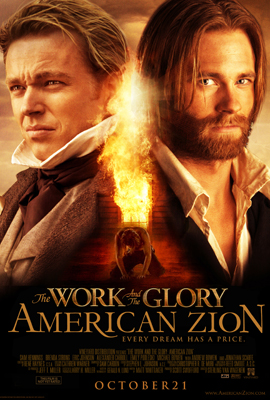
Review: The Work and the Glory: American Zion

The primary problem in dealing with a film like The Work and the Glory: American Zion is its episodic nature. Kind of like the second of The Lord of the Rings, American Zion has neither a real beginning nor a real end. After quick introduction to the characters and back-story, the film begins with the marriages of Nathan and Joshua Steed and ends with all narrative and thematic threads up in the air. Though its episodic form is understandable, I still think some temporary closure could have been brought to the some of the storylines, at least so that it felt more like a movie than an episode of a soap opera. Overall, though, I do think it’s a better product than its predecessor.

The script balances well between the factual historical events and the more personal on goings of the Steed family. Though he still doesn’t believe in the church itself, Benjamin (Sam Hennings) is coming to terms with the fact that his family does, and eventually moves with them to Kirtland. Meanwhile, Joshua (Eric Johnson) is adding fuel to the anti-Mormon sentiment in Missouri. I appreciate the underlying Christianity in the family conflicts. Nathan (Alexander Carroll) names his son after his hateful, rebellious brother Joshua and Joseph Smith (Jonathan Scarfe) tells Benjamin, furious over the behavior of his son, that Benjamin himself is the one who needs to repent and forgive Joshua.

We see a great deal of Mormon persecutions: an early imprisonment of Joseph, the tar and feathering of Joseph in Kirtland, the ravishment of the Jackson County saints that prompted the formation of Zion’s Camp, and the destruction of W.W. Phelps’ printing press. The line between the humanness and saintliness in Joseph’s response is well done. He doesn’t give into all the persecutions as a quiet martyr, but there’s a striking nobility in his reaction – it is exactly as you would imagine a prophet would be.

One problem with the persecutions is that we almost never get a sense of where the persecutors are coming from. No doubt their motives were largely irrational, but irrational motives are better than none at all. For a long time we are left completely in the dark as to why they keep attacking the saints. The one time we are given a reason comes as the Missourians plan to kick the saints out of their neighborhoods – because the Mormons are abolitionists. I understand that was indeed one of the problems, but it alone seems a bit simplistic.

American Zion has received some criticism for its heavy-handedness, which I am somewhat sympathetic to, but one thing that those unfamiliar with church history often miss is that the history itself is heavy-handed! If the film had wanted to drive in the persecutions and trials of the saints in this period, there’s so much more it could have done. In the Kirtland tar and feathering of Joseph, as I recall, Joseph’s tooth was broken and he thereafter spoke with a slight whistle in his speech for the rest of his life. We don’t see that in the film, nor do we see how painful a tar and feathering really is. The whole episode is underplayed, as I see it. We also see very little of the violent sacking of the saints in Jackson County. If the film were pure fiction, I could agree to the accusations of heavy-handedness, but this film is really just barely brushing up against the major plot points of church history.

American Zion is not directed at Mormons per se, by which I mean you don’t need to know anything about Mormons to follow anything in the story. But I don’t see anything here that I think non-Mormons will get very excited about. When it’s not going over church history, characters are struggling with whether or not to believe in the church. If it weren’t for a great production value, you could almost mistake it for one of the free DVD’s that you can get from the church by calling a toll-free number. But for those who believe, it’s an often touching, sometimes powerful reminder of the faith of our forefathers.

10.20.2005

News: Mormon movie update

Some brief notes from all over:

States of Grace now has an official release date: Nov. 4. Also, Richard Dutcher is releasing a 2-disk deluxe edition of God’s Army. Just in time for Christmas, kids.

The Work and the Glory: American Zion is opening in an unprecedented 200 theaters this Friday. For reference, I think Mobsters and Mormons opened in 32. The first Work and the Glory reached 117 and The Other Side of Heaven eventually reached 306. But 200 is by far the widest opening. I’ve also noticed a remarkable advertising campaign for American Zion – I’ve seen advertisements on Rotten Tomatoes, Fandango and other sites around the web. It looks like this one has a good shot at “breaking out” into a mainstream audience and could possibly be the highest grossing LDS film yet.

A trailer for the upcoming Church Ball is up. Hey, if they've got Fred Willard, it can't be that bad.

American Mormon was successful enough to spur a sequel, currently in progress in Europe. They now have a blog on which they will post podcasts, the first is up already. It’s nothing too interesting, just an introduction to the project really.

Speaking of podcasts, John Moyer, who directed Mobsters and Mormons, and Nathan Smith Jones, who directed The Work and the Story, did a three part podcast on LDS film. There are a few interesting tidbits, but there’s a lot of inanity and wasted time.

One point I did think kind of funny was John’s mention that, in its opening weekend, Mobsters and Mormons was the number two film in Provo theaters – second to The Exorcism of Emily Rose. He expresses some frustration that Mormons are always saying that they want clean, wholesome films, and then go to Exorcism instead. But I’m not sure that the two films share the same audience, even if both audiences are Mormon. I mean, I can’t imagine too many people were looking at the selection and asking “Well, should we see Mobsters and Mormons or The Exorcism of Emily Rose tonight?”

The last half of the third part is a review of Eric D. Snider’s review of Mobsters and Mormons, wherein they spend as much time making personal insults toward Snider as talking about the review. The whole thing sounded to me like some bitter kids who had been criticized and had to find some childish way to get back. There’s nothing wrong with defending your film, but Moyer was just hitting back. At an AML conference last year Eric Samuelsen said that the number one thing standing in the way of better Mormon stories and films was writers’ inability to accept criticism and suggestions of revision. It seems to me that these guys are just proving him right.

10.11.2005

News: P.G. Karamesines reading in South Jordan Oct. 12

AMV's own Patricia Gunter Karamesines will be reading from her award-winning novel The Pictograph Murders at 7 p.m. Wednesday, Oct. 12, at the new South Jordan Library (10673 South Redwood Road, West Jordan, UT). Patricia says that this will probably be the last reading she does in awhile so tomorrow is your last chance to take hear the voice behind the words.

Details at the Salt Lake County Library Web site (okay so not much more there than what I have posted, but there's other stuff of interest).

Hat tip: Darlene at the AML List. And a note to all Bloggernaclites and esp. AMV contributers and commenters -- if you have a cultural-related event or publication to announce, don't be shy. E-mail me.

News: Wayne C. Booth died Oct. 10

The New York Times is reporting that eminent literary critic and theorist Wayne C. Booth has died (free registration required). He was 84.

Booth was raised Mormon and served a mission, but he struggled with his faith and later grounded himself in secular humanism, basing his worldview on skepticism, rhetoric and ethics. However, he continued to engage with Mormonism, writing on Mormon literature and criticism and regularly participating in Mormon cultural fora. His work influenced faithful Mormon critics, including Richard Cracroft and Eugene England.

At the time of his death Booth was George M. Pullman Distinguished Service Professor Emeritus of English of the University of Chicago. His most famous works include The Rhetoric of Fiction and The Rhetoric of Irony. I highly recommend both. He is also the author of The Company We Keep: An Ethics of Fiction.

10.04.2005

Admin: Comments form change because of spam attacks

A Motley Vision has recently suffered several attacks of comment spam. This has necessiated activation of Blogger's only spam defense -- a word verification system.

However, activating the word verification means that the Metempsychosis hack doesn't work as smoothly as intended. Commenters can still use the form at the bottom of each post, but when they submit their comment, they will then be asked to type in the word verification and will need to either click the 'anonymous' button or input their Blogger username and password.

Now, one might ask why I don't just ditch the hack and force everyone to use the Blogger form.

Two reasons:

1. The Metempsychosis form is still superior, imo, to the Blogger form.

2. More importantly, the Metempsychosis comments hack means that the front page of the blog lists the most recent comments. Since AMV generates a low yet steady number of quality comments, this is a service that is of great benefit, in my opinion. And it's one that -- to my knowledge -- Blogger doesn't offer.

I apologize for the inconvenience and hope that it doesn't discourage would-be commenters. I will also look for other solutions -- Some short term; some long term (i.e. a move to Drupal, WordPress, etc.). Suggestions are welcome. E-mail address is near the top of the left column.

10.03.2005

News: Darren DeFrain reads from his novel 'Salt Palace'

The Ogden Standard-Examiner has posted a clip of Layton native Darren DeFrain reading from his debut novel The Salt Palace. Unfortunately, although the paper calls it a "Podcast," it's a streaming clip.

The Salt Palace will be published this month by New Issues Press.

Here's what they have posted by way of marketing copy:

"'If you think we don’t need another heavily footnoted Mormon road trip basketball novel, think again. With this unorthodox gem, Darren DeFrain creates a genre of his own, with the athletic ease of the Angel Moroni going in for a lay-up. Thoughtful, deadpan, shot through with comic inspiration, it’s a debut worth doing the wave for.'

—J. Robert Lennon, author of Mailman"

I'm intrigued. This sounds like the first attempt at a Mormon Eggersian/Foerian/David Fosters Wallaceian novel.

More about the novel, including a preview of the first chapter, is available on DeFrain's Web site.

EDIT: FYI, some AMV readers might be offended by the language of the first chapter posted on DeFrain's site (acutally it's the first two chaptes). However, to my recollection, the audio clip contains no offensive language.

EDIT II: Some also might quibble with some of DeFrain's descriptions of Mormonism in his footnotes. I find them to be mixed -- some are fair (albeit from an outsider-ish perspective); some aren't. And I still find this novel interesting and have asked for a review copy. It's also going to be an interesting test of the national market to see how many reviews this novel receives. Considering that it's being released by a small press, I would expect there to not be many. Whatever happens, it'll be interesting to see how critics deal with the Mormon elements of the work.

EDIT III: One more blurb -- this confirms my interest in the novel and offers the hope that it will fall in the tradition of Udall's The Miracle Life of Edgar Mint or Peterson's The Backsliders, rather than, say, Evenson's Father of Lies.

"'The Salt Palace is a novel that zigzags across America, across our religion-soaked history too: our national obsession with shorter, faster routes to redemption. Its protagonist, Brian, leaves his claustrophobic life in Michigan to revisit his childhood home and faith. He wants to live in it, and outside it too, sampling all the generous, heady, forbidden sensation. He makes this trip with a one-armed, splinter-sect prophet who might be a lunatic. It's never clear. Neither is the right path. Yet Brian and therefore the reader is granted a fleeting glimpse of a grace-filled, ecumenical afterlife the most cynical of us would be glad to inhabit. I loved this novel, its risks and realities.'

-- Debra Monroe, author of Shambles, Newfangled, A Wild, Cold State, and The Source of Trouble"